Tuesday, July 14, 2009

Film Review: The Hurt Locker [B+]

Film / Review

The Hurt Locker [InRO]
Director: Kathryn Bigelow
Year: 2009


Three American soldiers pace cautiously around a cluster of bombs in an Iraqi village as children from balconies and storekeepers from street-level doorways follow their every move. Tension builds throughout the opening scene of Kathryn Bigelow's gut punch of a war film, "The Hurt Locker," stemming here from both the impending detonation and from the threat the many villagers pose, each possibly concealing a detonator and just waiting for the Americans to get close enough to set it off. There are certainly more subtle ways to establish suspense than by introducing a bomb in the first sequence of a film, but, as evidenced from the subsequent explosion and brilliant visual collage of rust scraped from a car's body and sand blowing sky high like a geyser, Bigelow means to heat things up quickly and shake you.

The abrasiveness of the “Point Break” auteur’s latest may be its legacy, but there's still a lot more depth here than in one of Michael Bay's CGI'd-to-hell, soul-sucking demolition derbies. In 'Hurt Locker,' we’re shown a humanity representative of American-bred competition and easily agitated tempers, of loyalty to ones brothers and their country, and of fear, the kind spurred by living in a nightmare conflict like Iraq. It's the open-wound vulnerability of Bigelow's characterizations, seeping through layers of macho posturing and bulging muscle, that gives her film its beating heart, but it's both the filmmaker's willingness to avoid sentimental manipulation and the control she wields over her brawny aesthetic – the brutal poetry of her image sequencing and complementing intensity of her intricate sound design – that gives "The Hurt Locker" its quickening pulse.

Anthony Mackie (who stole the show in 2006's otherwise overrated "Half Nelson") and Brian Geraghty play soldiers in a three-man unit tasked with disarming bombs daily under increasingly hostile and dangerous circumstances (one of the film's most searing visuals: a soldier tugging the cord on one bomb and unearthing about a dozen more, forming a circle around him). Both actors excel in their respective roles as level-headed, methodical Sergeant Sanborn (Mackie) and Specialist Eldridge (Geraghty), the latter so psychologically damaged by his experience in Iraq that he’s resigned to the inevitability of his own death. Three more big actors have brief, somewhat distracting cameos: Guy Pearce as the unit's initial leader; David Morse as a stupidly grinning, broadly mounted jab at American war-hawk generals; and Ralph Fiennes as a British military officer the unit comes across in the middle of the desert. But 'Hurt Locker' is essentially a character study, and its predominant subject is Staff Sergeant William James, a man who seemingly derives pleasure and thrills from his unfathomably dangerous job.

Rising star Jeremy Renner plays James, delivering his most potent performance in a career that's built up momentum over the past decade, with the actor standing out in popcorn fare ("28 Weeks Later"), more dramatic roles (Michael Cuesta's "12 and Holding") and sharing the screen with the likes of Brad Pitt, Casey Affleck and Sam Rockwell as the tragic renegade in 2007's sprawling revisionist-western, "The Assassination of Jesse James by the Coward Robert Ford." But in 'Hurt Locker,' Renner delivers his most mature performance to date, wringing psychological complexity and emotional depth out of a role that could have been just another riff on rebel-without-a-cause contrarianism, and one that hinges on our understanding his particular mindset. Likewise, Mark Boal's sharp screenplay lets Renner act rangy and impatient, even mean and unfeeling, but gives us a glimpse of his private, more reflective side, establishing a believable inner conflict without being obvious or forced.

An unspoken parallel here would be with Sam Fuller's great Korean War picture, 1951's "The Steel Helmet," where a Sergeant James-type loner (Gene Evans, in one of his earliest roles) is softened by the warmth of a South Korean child. In 'Hurt Locker,' it's a young Iraqi boy, selling DVDs and all manner of bootleg entertainment to American soldiers, who's much more self-serving and sly (such are the times), but who enjoys playing soccer with James as the soldier slips him money and gives advice. It's a different kind of bond than that in Fuller's film, but serves as the same gesture: a cultural union formed in the midst of a warring time through mutual appreciation and respect. In fact, Bigelow is a filmmaker who has a lot in common with Fuller, in regard to both her willingness to toe sentimental waters and her ability to side-step manipulative gestures, rarely if ever lessening the impact of her guttural and gritty action films.

Considering all that Bigelow gets right with "The Hurt Locker," working within the already tired Iraq War genre and coming out the almost inarguable victor (with competition the likes of Kimberly Pierce's shrill "Stop-Loss" and Irwin Winkler's weepy and pathetic "Home of the Brave," few should contest this), it's easy to overlook the director's few missteps, most taking place in the film's somewhat jumbled third act. 'Hurt Locker' is 106 minutes long, and since the film has no real plot and is mostly made up of episodic bomb-disarmings, the last one or two of these sequences could probably have been scrapped. More noticeable, however, are the two rushed plot tangents the film follows immediately after its incredible climax, both of which relate to irrational and forced decisions made by the brash Sergeant James. But Bigelow quickly rebounds with her fittingly stunning finale, a conclusion which to some may seem too hopeless, but one that feels like the only logical end for the character Bigelow and her team have given us. It's "The Hurt Locker's" defining moment, and one that reveals Bigelow's ambition with this project. In this critic's opinion: mission accomplished.

Tuesday, June 16, 2009

Music Review: Dirty Projectors [A-]

Music / Review

Dirty Projectors [BlogCritics]
Album: Bitte Orca
Year: 2009


No release this year better represents a realization of potential than the new album from off-kilter indie collective Dirty Projectors. That Animal Collective record we all know and love could be seen as a similar document in this regard, but whereas the triumph of Merriweather Post Pavilion is that of a band in peak form, exercising their long-established skill, the level of success Dirty Projectors attain on Bitte Orca is of a kind they've never before reached.

As chronicled in a series of eccentric albums, the odd EP and one truly confounding reproduction of Black Flag's punk landmark Damaged from memory (2007's Rise Above), lead Projector David Longstreth has proven himself a restless prodigy, delivering inconsistently brilliant collections with just as inconsistent a line-up of musicians under the Dirty Projectors moniker. It's always been apparent that his band, no matter what the incarnation, are a formidable indie-rock collective, but the material they've churned out in the past – wildly eclectic and often maddening compositions coupled with Longstreth's otherworldly falsetto – have made for a musical output much easier to admire than love. Shards of Longstreth's more crystalline art-pop tend to find themselves sandwiched between lesser experiments.

Take, for example, the meandering crashings of "Room 13" and the halfhearted sketch of "Untitled" surrounding perhaps the band's best track, "Rise Above," on the album of the same name. Or the David Byrne-aided "Knotty Pine" nearly drowned out by the mediocrity pervading the Dark Was the Night compilation it's a part of. Not so with Bitte Orca though, a collection of nine songs, each just about as good as anything the band's ever done.

This isn't just a great album, it's some kind of lightning-in-a-bottle miracle; Longstreth has managed to channel his tendency toward going-nowhere diversions into one song: "The Bride," the only weakness in this whole set which, in reality, is about as compelling as all the other doodles Longstreth has given us (which is to say it's no disaster). Complaints about this album end there, as no other major missteps occur in the 41 minute length between the electric guitar chime of opener "Cannibal Resource" and the fading synths which close percussive stunner "Fluorescent Half-Dome." That's not to say Longstreth and company have abandoned their more artistic impulses for catchy, streamlined pop; it's just that the more jarring moments on Bitte Orca always feel cohesive and never threaten the progression of the songs.

Consider the R&B-influenced "Stillness is the Move," which wouldn't be half as compelling and daring without the clipped guitar chords that give it an Afro-pop flavor (surely one of Longstreth's favorite musical stylings). It's one of two songs which make up the middle section of Bitte Orca, both sung by Dirty Projectors' dual female members.

Sighing siren #1, Angel Deradoorian, takes the mic for 'Stillness,' tapping into the same poppy vocal runs that make the best of Mariah Carey and Beyonce's output so winning. The track chimes nervously and clangs loudly until the appropriately angelic bridge hits: Angel's layered vocal is given front-and-center treatment backed only by a subtle bass pulse; each of the other elements of the track reenter the mix one by one, plus a swelling string section well-complementing Angel's high-pitched tenure, and the whole thing ascends into the heavens – and to the top of the list of 2009's best singles.

Amber Coffman, her voice of an earthier and huskier quality than Angel's, croons over the other feminine track of the set, "Two Doves," her voice gliding atop quivering orchestrations and Longstreth's intricately composed acoustic picking. "Kiss me with your mouth open," Amber insists, and at first the song seems like a love ballad, until the singer starts dropping words like "killer," and the real shocker: "Our bed is like a failure." The song ends with Amber pleading "call on me," her voice cracked and broken and her plea left unanswered. It's the album's most devastating emotional blow, and not without competition.

Longstreth-led pieces are just as impressive, if not more so. Like his talents as a composer, his skills as a guitar virtuoso need not be proven further, but Longstreth doesn't seem to be listening; he cooks up more than a few devilishly catchy and technically mind-boggling rhythms here, on "Temecula Sunrise" and on the album's most dazzling stand-alone piece, "Useful Chamber." Six and a half minutes of tempo shifts, surprise bridges, a fashionably late chorus and Yes levels of prog-rock cacophony make up "Useful Chamber," which has to be seen as the most successful meshing of Longstreth's restless desire to experiment and, um, listenability. The revelatory moments come fast and furious, but how about the sudden assault of layered electric guitars or the yelping of the album's title – didn't see either coming.

It's almost unfair to point out this stuff, since a great deal of this album's allure is in discovering the unexpected directions it takes. This quality firmly aligns Bitte Orca with another of this decade's defining art-rock statements, 2004's mammoth Fiery Furnaces album Blueberry Boat. Both pride themselves on unpredictability, and making the listener an active participant with the music rather than a passive one.

In this sense, the comparatively predictable progression of the album's last three tracks ("No Intention," "Remade Horizon" and "Fluorescent Half-Dome") could be seen as a flaw. But "No Intention," a decidedly more relaxed Longstreth tune, also ranks as one of the artist's more soulful vocal performances, his "Two Doves" moment of emotional rawness. And check that wacky bridge; dueling guitars fight for supremacy, complemented by Amber and Angel's alternating "woos" and "oos." It's followed by "Remade Horizon," probably the album's most cryptic moment lyrically, but no less inventive and engaging musically, further elevated by the playful vocal interplay between all three principles. And finally, "Fluorescent Half-Dome," the most spare track here and an appropriately subdued closer which relies heavily on propulsive, meticulous percussion, a recurring theme of this album exemplified more here than at any other time on Bitte Orca.

In performance, the giraffe-necked Longstreth is a twitchy mess of tics, refusing to sit still; in interviews, he's even worse. In the studio, we can only imagine. It remains to be seen if Longstreth has actually gotten his shit together or if this is indeed a fleeting moment of brilliance to be followed by the same uneven work we've come to expect from the artist. But really, it doesn't matter; we'll always have Bitte Orca, Dave, and for that I'm sure we can tolerate whatever bonkers thing you choose to do next – The Beatles' White Album played backwards, perhaps?

Film Review: The Taking of Pelham 1 2 3 [C]

Film / Review

The Taking of Pelham 1 2 3 [InRO]
Director: Tony Scott
Year: 2009


Despite my general indifference toward Tony Scott's taut, but largely uninspired remake of the 1974 thriller “The Taking of Pelham One Two Three,” I'll be one of the first to stand up and defend the director, and to champion some of his most critically reviled offerings. In fact, I'll anger the naysayers one better: Tony Scott is an artist who brings more verve, originality and overall quality to his medium than his overrated older brother, Ridley. The younger Scott has been continually criticized for his hectic visual aesthetic; speed manipulations, whip-quick editing and breathless camera hurtling are his bread-and butter. But his films are among the few pumped out by the Hollywood machine that earn and are even strengthened by their hyperactive pacing and stylistic choices. A consummate auteur, Scott is nearly always in control of his own special-FX maelstroms. See 2005's “Domino,” a flawed and convoluted, densely plotted actioner-on-steroids that succeeds by the sheer force of stylistic fervor it musters; it's fueled by a myriad of aesthetic modulations and a striking use of color that directly correlates to the emotions of its characters. And take 2006’s “Deja Vu” (a film I myself underestimated when reviewing it on its release), which relies on ghostly sci-fi visualizations to fuel its emotional conflict in ways that far best brother Ridley's own psychological sci-fi favorite “Blade Runner.”

“Deja Vu” is a particularly relevant point of reference when discussing Scott's latest, which alters the original's title slightly; now “The Taking of Pelham 1 2 3.” Both are elevated by the considerable talents of Denzel Washinton in their respective leading roles, an actor who possesses stoic humility and quiet strength that well-compliment the modest means of Scott's storytelling and classically drawn characters. And, like “Deja Vu,” ‘Pelham’ revels in technological advancements with a focus on surveillance – a theme that pervaded both the former, essentially an exercise in voyeurism, and “Domino” in its Reality TV show commentaries – that informs the aesthetic choices Scott makes. Take, for example, the claustrophobic and humiliating nature of its central character's desk job, emphasized via a massive glowing billboard symbolic of looming responsibility. It's an intentional aesthetic choice that many will write off as mere flashy distraction.

Washington plays the soft-spoken Walter Garber, an NYC subway dispatcher who becomes inescapably entangled with a bombastic hijacker calling himself Ryder (John Travolta, tattooed on the neck with eyes and veins abulge), tasked with negotiating a hostage situation. The set-up again speaks to “Deja Vu,” where Washington's detective developed a relationship with the object of his investigation through a futuristic screen, allowing him to peer into her past life. The communication between Ryder and Garber is also limited, this time by the auditory connection between the subway's radio and the dispatcher's microphone. It's a noteworthy emphasis on the distorting or even damning effects of communication through technology. The near entirety of ‘Pelham’ keeps this focus: the film is largely comprised of the ongoing dialogues between its two principals, their faces shot in intense close-ups (an annoying visual motif Scott would do well to ditch). Through their conversations, we learn that Garber was once an MTA big shot who was demoted after accepting a bribe. Even though Washington doesn't leave his cubicle for at least two thirds of the film, he ably conveys Garber's internal struggle as he wrestles with moral responsibilities. And each time his character plaintively insists, "I'm just a guy," his every-man statement could be read as thesis for the film's dramatic pulse.

In addition to criticisms over his stylistic choices, Scott is also often accused of "cliched" depictions of modest characters undertaking heroic acts for the sake of their own atonement. However, it's evident in Scott's filmography that there is a very spiritual undercurrent to his work. In this sense, “The Taking of Pelham 1 2 3” can be seen as the conclusion of a trilogy that began with 2004's “Man on Fire” and continued with “Deja Vu.” In each film, Washington takes on the role of Scott's morally conflicted characters, haunted by prior sins or transgressions, and in need of redemption. There's a very Christian ideology present: the need to redeem the spirit through selfless, righteous action. ‘Pelham’ takes its religious convictions one step further than the prior two films; where Washington struggled against largely faceless evils before, here Scott introduces a struggle of faith between both his two principles. (This is evident in Ryder's observation that his cramped, commandeered subway car "reminds me of a confessional.") Unfortunately, this provocative thematic implication never really ignites or goes anywhere; instead, we're left with Travolta's frustratingly one-dimensional and shrill "villain." Ryder is a cartoon, he practices a dubious code of conduct and lectures about stock trades and corporate corruption – relevant economic commentaries only name-checked here.

Further perplexing is Scott's comparatively staid visual style in this film, at least in regard to all that takes place between its amped-up opening credits (a characteristically bonkers assault of aesthetic tweakery) and a last act so frenetically assembled that it's difficult to determine what exactly is going on (not unlike many other Scott productions). The majority of ‘Pelham’ though is not driven by special-FX at all; instead, Scott favors a succession of talking heads deliberating over the various conflicts of this procedural's plot. Tension is maintained throughout (a byproduct of those claustrophobic close-ups mentioned earlier), but it's tough not to compare ‘Pelham’ to Spike Lee's hostage-negotiate-er “Inside Man,” which bests Scott's film both stylistically and in the inventiveness of its plotting. But the most egregious of missteps here manifest in noticeably forced action scenes – on the way to deliver the requested sum of 10 million dollars to Ryder, there are not one, not two, but three police car crashes. And in a dubious approach to violence, as Scott undercuts his own morally-conscious ideals. (One scene of ludicrous brutality witnesses two of Ryder's cronies being shot to pieces in super slow-motion.) Again though, this is the norm in a Tony Scott movie: over-the-top displays of action making for sometimes uncomfortable bedfellows with earnest sociopolitical commentaries (a formula paramount to this filmmaker since at least 1998's “Enemy of the State”).

Under less scrutiny, “The Taking of Pelham 1 2 3” succeeds as a tense thriller, ratcheting up suspense and keeping the stakes high as it barrels toward its appropriate finale, and is further admirable for placing emphasis on the struggle of its every-man protagonist over the clipped rhythms of its plot (a headache-inducing complexity which, if one really considers Ryder's motivations, is pretty silly). It's a well-made film mostly of a consistent and agreeable style, and it rarely suffers from pacing problems. But it's derivative (it is a remake after all) and lacks the jolt of energy and enthusiasm that invigorates Scott's best films (1993's “True Romance,” as well as the aforementioned Washington-Scott collabs “Deja Vu” and “Man on Fire”). But those who dislike Tony Scott's prior films may find his latest more digestible; it is, after all, the least characteristic film from this divisive auteur in quite some time.

Wednesday, June 3, 2009

Cannes Reviews: "Antichrist" [B] & "Mother" [B+]


Film / Review


Antichrist [The Playlist]
Director: Lars Von Trier
Year: 2009


"Antichrist" is an exorcism of the foulness and unmitigated hatred stewing inside notorious provocateur Lars von Trier. It's production follows a crippling depression which stifled the Danish master's output for two years, following completion of what could be described as the filmmaker's only conventional film, 2006's office comedy "The Boss of it All." This new work finds von Trier coming out the other side of the woods and leading us in: "Antichrist" is set in the heart of a forested landscape known ironically as "Eden."

The film's proverbial Adam and Eve (the cast lists them as "He" and "She") are played by the willowy Charlotte Gainsbourg and previous von Trier collaborator (in 2005's "Manderlay") Willem Dafoe. The couple recently lost their only son (a tragedy depicted as the couple has unbridled sex in the film's heavily-stylized black and white prologue, arguably the most accomplished passage of film this director has ever produced), and the wife has been stricken with inconsolable grief. Her husband (who is also a therapist that arrogantly decides to treat her) attempts to console and rehabilitate his spouse, repelling her sexual advances and embracing her firmly each time she awakes from vivid nightmares. But after the Doc's usual tricks prove largely ineffective ("make a list of what scares you" and "exhale on the count of five," he instructs) it's decided that he must pursue a more severe approach and face her terrors head-on. He leads his wilting wife into a cabin in the woods - into the forest of Eden, the place she fears more than any other.


Unsurprisingly, what the couple find in their foliage-ensconced retreat is nothing less than hell on Earth; a fiercely primal series of brutal acts which She inflicts upon Him in some kind of possessed fury and misguided vengeance. Lars isn't fooling around: within the first five minutes, brief penetration is shown on screen (goodbye R-rating), and later on, one character is forced to ejaculate blood and another takes a pair of sheers to their genitals (hello NC-17). All this ultra-violence is given some context through Gainsbourg's pained whisper of a warning: "Nature is Satan's church."


Sentiments like these are more than appropriate considering that von Trier has dedicated "Antichrist" to Russian master Andrei Tarkovsky (a dude who seems really popular all of a sudden) whose films were always heavily influenced by their natural environments. Acts of carnality and physical abuse are suggested to be provoked by the influence of Eden's foreboding landscape, which complements the film's primal urgency (especially in regard to the un-sexy and desperate sexual encounters, of which there are many). It's frustrating then that von Trier introduces a more academic motive for the wife's horrific behaviors: we learn that she was working on her Masters Thesis regarding the mistreatment of 18th century woman, suggesting that all this mayhem is the result of some kind of demonic possession (and or just some good ol' misogynistic statement on his part).


And then there's 'the three beggars,' a trio of recurring woodland creatures (a deer, a fox and a crow) who pop up in horrific succession during the film. Their implication here is riotous: a fox actually talks at one point (the only point, "Chaos reigns!" he groans, covered in blood from eating himself alive) which understandably was met with hysterical laughter at the premiere screening (and all others for that matter). This is a consistent failing of "Antichrist": the more serious and provocative moments are too ridiculous to be taken as such, and thus often come off as comical, and we have to assume that's not what von Trier was aiming for (though who knows with this guy).


Yet however dubious the usually on-point von Trier's symbolic implications may be in this equally dubious return to the horror genre (isn't he past this phase of his career?), his craft is still undeniably accomplished. Both the opening and closing sequences of "Antichrist" have an elevating quality to them that could easily excuse whatever comes between, but von Trier further stuns with his impressionistic therapy sessions, which find the husband instructing the wife to visit the forest in her mind and let it absorb her body-- a sort of catharsis before the storm.


When the tempest of brutal, unrelenting violence does hit (like a brick to the dick-- no, literally) von Trier's depiction is just as arresting as it is in his more leisurely sequences. It's a nasty bit of business for sure, frankly depicted without an ounce of irony, and sure to be the cause of many a sleepless nights and heated debates between cinephiles and casual moviegoers alike (that is, if people are actually given a chance to see this thing; I can't imagine "Antichrist" scoring much of a domestic release, what with its likelihood of making the straight-laced MPAA lose their shit).


We've been known to bemoan the popularity of the torture-porn genre fervently, so we would feel hypocritical endorsing "Antichrist" and excusing it of similar transgressions. However, the fact is, this is moving cinema; whether you're moved to love it, moved to hate it, or it just churns your stomach with wretched bile, "Antichrist" will undoubtedly inspire a passionate reaction among those who see it.


So even if Lars von Trier isn't the "best film director in the world," as he so boldly and, we would assume, tongue-in-cheekily proclaimed in a recent press conference, he's still unquestionably the boss of it all-- a unique artistic force who plays by his own rules and answers to no one.


"Antichrist" is, appropriately, an exorcism of hatred and malice from the grimiest bowels of Danish provocateur Lars von Trier, ending a career stifling depression. One question: if this is the aftermath of the director's episode, how fucked up was the real thing?


Film / Review

Mother [The Playlist]
Director: Bong Joon-Ho
Year: TBA


Following his crowd-pleasing, box office record-breaking monster movie "The Host," which premiered at Cannes in 2006 as a Midnight Screening, South Korean filmmaker Bong Joon-Ho returns to the genre of his second feature film, the "Zodiac"-esque mystery thriller "Memories of Murder." The director's latest Cannes entry (premiering in Un Certain Regard) is another procedural, this time concerning a widow's attempt to clear the name of her mentally handicapped, 28-year-old son, who is accused of brutally murdering a young woman.

All of Bong's films (even the director's loopy rom-com debut, "Barking Dogs Never Bite") are notable for their riotous entertainment and their equally pointed socio-political commentaries, and while "Mother" certainly brings the entertainment (like Bong's other films, it's brisk and breathlessly suspenseful, with twists manifesting at all the right moments to sustain the tension) it doesn't seem to be pushing any broad message or moral. Instead, the picture's primary theme is one of maternal devotion: As the title suggests, this is a film about a mother, one whose role as such takes precedence over anything else.


"Mother" sometimes recalls Akira Kurosawa's early noir "Stray Dog," as it surveys a small town rote with secrets and latches on to the desperate, human struggle of its inexperienced detective. Our gumshoe is the titular mother, Hye-ja, played startlingly by middle-aged actress Kim Hye-ja, whose facial contours and wide, sad eyes communicate her character's exasperation. It's a performance that channels the ferocious femmes of Pedro Almodovar's best films with fervent, melodramatic intensity.


Another South Korean genre film at Cannes this year, Park Chan-Wook's noxious vampire thriller "Thirst" (which is infuriatingly in the competition section at this festival), dumps heaps of self-serious exposition in effort to explain the motivations of its protagonist. Bong, too smart and skilled a craftsman to waste a second, opens "Mother" with a surrealist sequence (the first of two bookending passages) which tells us all we need to know about his fickle heroine-- her strength, grace and even her loneliness-- absent the heavy-handed lecturing of Park's film.


From here, "Mother" immediately kicks into high gear, leading into a hit-and-run incident which sends characters scurrying about their small, rural town and sows the seeds of a hard-boiled procedural.


Do-joon (Korean television star Won Bin), Hye-ja's mentally handicapped son, is hit by a passing Mercedes Benz and convinced by his headstrong friend to take revenge. The two track the automobile to a golf course, where they think they've found the culprits (a group of unsuspecting yuppies), and then proceed to bash their faces in. This understandably earns the attention of the police, and when a later crime is committed (the death of a promiscuous schoolgirl), Do-Joon, who was even seen at the scene of the crime, is convicted and jailed.


Convinced of her son's innocence and angered by law enforcement's unsympathetic response to his condition, Hye-ja turns to a pricey lawyer and a friend on the force for help. But when no one seems to give a damn about her and Do-joon, all it takes is some bold advice to make Hye-ja take matters into her own hands: "Don't trust anyone...you go out and find the real killer yourself." Bong's film then quietly segues into the realm of a vigilante picture, akin to Clint Eastwood's "Changeling" (a Cannes official selection last year) but with much more narrative focus and a decidedly sharper characterization of its distressed parent.


"Mother" sits well alongside Bong's other films and acts as a sort of compromise between the absurdist fantasy elements of "The Host" and the more plot-driven social-realism of "Memories of Murder." It's not this talented Korean auteur's best film to date, but it does help solidify his status as one of the most gifted directors of his generation (even with only 4 films to his credit). Bong looks to the age-old genre of the film noir for inspiration, but unlike so many filmmakers who obsessively recreate the look and tone of the noir, Bong instead applies his own thoroughly modern aesthetic, but taps in to the same moral gravity which invested Kurosawa's most effective genre films ("Stray Dog," and also one of our favorites of the Japanese master's works, "High and Low").


Bong's "Mother" isn't flawless (it's probably a few scenes too long, with one too many plot twists piling-up towards the end), and its depiction of the mentally handicapped (or, rather, Won Bin's bug-eyed and cartoonish, one note rendering of his imbecilic character) takes away from the resonance of the film's central relationship. Still, as always, Bong's filmmaking skill is totally on point; his sweeping camera movements and evocative colorization complement the overall seething atmosphere of this often Hitchcockian thriller. And one scene, in which a major revelation takes place as a character stumbles backwards out of the frame, punctuated by a goosebump-inducing scream, is actually worthy of the overused Hitchcock comparison.


In any case, especially compared to the other films we've seen at Cannes '09 -- again feeling like a weak year so far -- "Mother" probably should have been accepted into the official competition selection.

Tuesday, May 12, 2009

Away Message: Gone to Cannes


Not that I update this old thing a whole hell of a lot anyway, but there will really be no updates over the next couple weeks, as I take to the Cannes Film Festival for the very first time.

Should be a blast, so be sure to check out what I'm doing/seeing over on InRO's Cannes Coverage page, where I'll be linking to my coverage for both The Playlist and Talk Cinema.

When I get back, expect some film reviews of Assayas' "Summer Hours" and of new filmmaker Lee Isaach Chung's superlative debut feature, "Munyurangabo." Both will be in theaters in the next couple weeks, and I'll say this much about them now: see them at the first available opportunity.

Until then: go away.

Friday, May 1, 2009

REVIEW: "Revanche" [3/4]


Film / Review

Revanche [The Playlist]
Director: Gotz Spielmann
Year: 2009


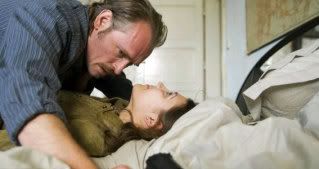
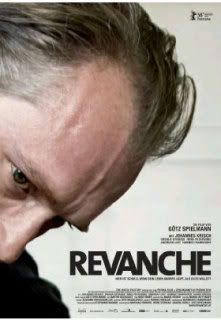
There's likely to be no better opening sequence in a film this year than that in Austrian director Gotz Spielmann's fifth feature, "Revanche." The quiet calm of a lake reflecting majestic trees on its surface is broken by a sudden splash, as something is thrown into the water from outside the frame. The philosophy of Spielmann's narrative reflects something similar: the slightest action can upset the flow of things. The sequence also expresses the important role nature plays in "Revanche," as the woods and the tranquility of the lake serve as a necessary retreat for Spielmann's morally conflicted characters.


Alex (Johannes Krisch), a brutish ex-con, works at a sleazy Vienna brothel, "The Cinderella," for slick and equally-sleazy owner Konecny (Hanno Poschl). Alex meets in secret with a Ukrainian prostitute from the brothel, Tamara (Irina Potapenko), promising the young immigrant a better life, far away from her scuzzy job and cramped, drab apartment. Meanwhile, Robert (Andreas Lust), a cop in a rural town outside Vienna, lives with his wife, Susanne (Ursula Strauss), in a luxurious house just through the woods from Alex's lonely grandfather, Hausner (Hannes Thanheiser). Predictably, disparate lives intersect when, in the interest of a better future with Tamara, Alex decides to rob a bank. And yet, what would normally be the catalyst for plot progression in a typical genre picture instead becomes the unconventional beginning to a slow-burning character study.


Similar to Florian Henckel von Donnersmarck's "The Lives of Others," Spielmann uses voyeurism to explore his characters' tortured psyches: Alex watches Robert and Susanne from a safe vantage point in the woods and, in the throes of his own moral crisis, he observes Robert's visible guilt. But, where von Donnarsmark's Best Foreign Language Oscar-winner progresses with an almost mechanical remove (and often contrivance), "Revanche" (which received a Foreign Language Oscar nomination last year, but did not win), unspools patiently, arriving at a more satisfying emotional climax.


Spielmann has been criticized for the role woman play in this film; however, "Revanche" is less about relationships (Robert's to Susanne; Alex's to Tamara) then it is about the shattering of a man's macho resolve. It's clear to everybody but Alex that his plan to rob a bank contradicts his character (his boss at the brothel tells him he's "too soft" for their line of work). Likewise, when Robert's buddies in the police force boast about a violent run-in, he bemoans missing out, yet when a similar conflict presents itself, he only regrets it ever happened.

In addition to his thought-provoking thematic concerns, the director also displays an impressive control of his medium. Spielmann frames his characters with wide shots, allowing us to inhabit the same grubby spaces, and using close-ups and obvious camera movement only when necessary, but his masterstroke reveals itself to be his use of location. The cinema of Andrei Tarkovsky is an obvious point of comparison: Spielmann has a knack for capturing nature with the same meditative grace of the Russian director's best work. Tarkovsky found aesthetic sublimity in his "Solaris" through that film's contrasting landscapes-- the warm embrace of nature giving way to the chilly isolation of space-- just as Spielmann accounts for Alex's spiritual rejuvenation through his escape from the confining urban sprawl of Vienna to the calming countryside. It's cause for excitement that there is a filmmaker working today who is this attuned to his environment, and the way in which Spielmann's revenge saga unexpectedly evolves into something more cathartic and meaningful would likely make Tarkovsky proud.


Friday, April 24, 2009

REVIEW: "Goobye Solo" [3/4]


Film / Review

Goodbye Solo [The Playlist]
Director: Ramin Bahrani
Year: 2009


Ramin Bahrani's first two films, 2006's "Man Push Cart" and 2008's "Chop Shop," wear the Iranian-American director's neorealist influences proudly, and their release marked the arrival of a significant talent. However, those films' tendency to shy away from any real form of tension or narrative momentum can seem forced, and the filmmaking skill on display isn't quite enough to elevate either above the designation of a modest achievement. Thankfully, "Goodbye Solo" steps up his craft, his storytelling ability and his characterizations, without compromising his dedication to realistic cinema, so rare to American independent filmmaking.


Bahrani's last film, "Chop Shop," is clearly indebted to classics such as Vittorio de Sica's "Bicycle Thieves" and Francois Truffaut's "The 400 Blows." In it, an impoverished young boy and his sister struggle to carve out a decent life for themselves amidst the garbage and rubble of a ghetto just outside Queens, New York. "Goodbye Solo," in contrast, is a film of prevailing and pervading hope, which finds its inspiration from a work of Bahrani's own heritage. Its basic plot is lifted from native Iranian filmmaker Abbas Kiarostami's "Taste of Cherry," but 'Solo' is considerably more engaging, favoring depiction of a strong and inspiring human connection between two unlikely friends, as opposed to the lonely wanderer at the heart of Kiarostami's film. Both are essentially about a man who seeks to end his life, but where Kiarostami found the grim subject matter to be a jumping off point for stoic meditation, Bahrani sees it as a catalyst for hope and renewal. It's that quality which makes 'Solo' both Bahrani's most compelling work, and his most optimistic.


The opening sequence here is jarring in its immediacy: We feel as if we've been dropped right into the middle of something that started before we got there. A garrulous Senegalese cabbie attempts to chip away at the frigid resolve encasing his grizzled patron. The affable cab driver is Solo, played by newcomer Souleymane Sy Savane (in one of this year's most striking debuts), and his passenger is William, a curmudgeon who has no interest in chit-chat. Vaguely recognizable character actor Red West inhabits the latter role, with a no bullshit attitude that's appropriate, considering West was once a member of Elvis Presley's "Memphis Mafia." William, who has no use for any kind of friendship, offers Solo a hefty sum of cash to drive him far outside the city limits, and his driver's reluctance to do so frustrates him.

Our introduction to Solo and William is their introduction to each other, and the unexpected relationship that develops between them sparks the kind of emotional connection that few films achieve. Much of that investment is owed to the actors, whose interactions have the sort of awkward chemistry that often occurs between two very different individuals. It's Savane who we're attracted to the most, but West ably tempers his screen partner's exuberance, and their presence as a duo ignites our interest in ways Kiarostami's solitary character study doesn't. Admittedly, Bahrani is not the visual artist the Iranian director is, and gritty photography of Winston-Salem, North Carolina doesn't approach the majesty of Kiarostami's poetic, sand-blasted terrains. Bahrani's cinematographer (Michael Simmonds) finds lush beauty in an early morning sunrise and texture in shots of Solo's nighttime cruises in his battered cab, yet the film's major visual coup arrives during its coda: a rapturous communion with nature that has a quiet intensity and lyrical quality on par with anything Kiarostami's done, and that seems earned in a film of straight-forward, character-based dialogues.


At a lean 91 minutes, the pacing of Bahrani's film is refreshingly disciplined: We're given enough insight into Solo's life at home with his pregnant wife and stepdaughter, without the film ever feeling aimless or stalling, as "Chop Shop" occasionally did. Solo "adopts" William and, once he learns of his suicide plans, he tirelessly attempts to invigorate the old man's life. Solo's intentions may be honorable and even noble, but his forwardness occasionally borders on obnoxious, and his meddling threatens to be destructive. His desire to help William stems not from a saintly perspective, but from that of someone who desperately wants a down-to-earth friend. His subtle, but noticeable confusion when he thinks he's not getting back from the relationship what he's putting in can only be described as human.


Pivotal moments such as the reading of a discovered diary, the opening of a letter and, most significantly, a wordless gaze between two men, are presented without intrusive musical accompaniment or any type of embellishment. Bahrani trusts the strength of his material and the tensions it naturally creates. So, in a sense, "Goodbye Solo" is every bit the stripped down and fluid narrative film as Bahrani's other two works, but this one has a propulsive momentum and purpose that the others lack. Bahrani may have always wanted to make films with a commitment to capturing real life, but "Goodbye Solo" feels like the first film of the director's career that, by its minimalist aesthetic, is emboldened rather than stifled.


REVIEW: "Observe and Report" [3/4]


Film / Review

Director: Jody Hill
Year: 2009


The Band's cover of Bob Dylan's "When I Paint My Masterpiece" plays during the opening sequence of Jody Hill's new black comedy, "Observe and Report," set to panning photography of a suburban mall intercut with close-up profile shots of Seth Rogen's dedicated mall cop, Ronnie Barnhardt. As in the classic opening sequence of Martin Scorsese's "Taxi Driver," the visual aesthetic establishes Ronnie's territorial attitude toward his mundane job. But the song is important too: the first of many 70s-era classic rock jams that play throughout Hill's twisted character study, often set to heroic and imagined montages of Ronnie's ironically unlawful actions. It's Hill's  genuine affection and even sympathy for this mentally-unstable misfit that gives "Observe and Report" a gravity few films of its kind can muster. Every scene escalates to inevitable confrontation, and it’s Hill's ability to make us care for his nutcase that transcends the film's vulgarity and violence.


Ronnie lives at home with his alcoholic mother; his father left around the time he was born, unable to cope with his son's "special needs." He's the head of security at a local mall, and it's a position he understandably takes very seriously. Aside from routinely courting make-up counter bimbo Brandi (Anna Faris), there's little to distract Ronnie from his duties, and when reports surface of a serial flasher, he resolves to catch the offender. Real Detective Harrison (Ray Liotta) is officially assigned to the case, but does little to deter Ronnie's efforts, and when Brandi is "targeted" by the flasher, Ronnie's obsession with nailing him is only emboldened. With assistance from right-hand-man Dennis (a hilarious, lisping Michael Pena), a couple of "expendable" Asian twins, and a rookie security guard, Ronnie assembles a "task force" to take down his pervert. Along the way, Hill's Apatowian man-child unsuccessfully attempts to become a real cop, learns the truth about a close friend, and finds out his crush is cheating on him. But because we get the sense that Ronnie has never experienced any such disappointments before, these unremarkable realizations play out in a way that seems abnormally weighty. Ronnie tries to be be better than what he is, better than what he's been content being, and inadvertently unveils the farce of his own delusions of grandeur.


This director means to provoke, as evidenced in sequences of brutal violence, blatant racism and drunken-induced date rape-- all acts committed by Ronnie. In "Taxi Driver," Scorsese's Travis Bickle is the product of the Vietnam War, a ticking bomb of violent urges and disgusted hate. In contrast, Hill's Ronnie is in some ways the product of movies like "Taxi Driver" and Quentin Tarantino's "Reservoir Dogs," and the director swipes the latter film's slow-motion, bad-ass posturing, approximating it here, but with new meaning: this is how Ronnie sees himself and his cohorts, and Hill wisely allows no other characters such visual accompaniment. This makes many of the seemingly flamboyant aesthetic choices, such as use of the montage, more appropriate, as Hill envisions them as character devices rather than stylistics. 


Rogen, who's mere existence in a film as of late has suggested banality, with seemingly endless comedic roles for the Judd Apatow machine that can only kindly be described as slight variations on the same character, here proves he's up to the challenge of doing something more with himself. Seemingly asked to play a modern day Bickle-- or, more accurately, one who believes himself to be a tough guy but clearly lacks the physicality and know-how-- Rogen delivers a believable intensity, deviating from the likable stoner of films like "Pineapple Express" and "Knocked Up," but harnessing enough of his schlubby persona to suit his character in "Observe and Report." The actor's chummy grins are present, but they mean more here, often masking insecurity or anger, and when Rogen needs to buckle down and get serious, as when Ronnie's house-of-cards emotional state calls for release, the actor's explosive outbursts possess enough shock value to keep them from feeling gimmicky. (This isn't "Happy Gilmore," "Billy Madison," or any other Adam Sandler tantrum comedy, after all.) And, since Hill's film is something of a character study, it's to Rogen's great credit that we almost entirely buy into Ronnie's mental state: He's bi-polar, racist, misogynist, violent, and a mama's boy. As such, Ronnie believes what his mother tells him, that he's a "great man," and if Hill doesn't buy it (the director is smart enough not to excuse his character's bad behavior), he at least makes us understand that Ronnie acts with his id, and because he thinks what he's doing is right.


This all sounds pretty heavy, I'm sure, but another strength of Hill's film is its comedy. The effectiveness of "Observe and Report" as anything more than mere amusement is surely debatable, but anyone who can appreciate the inherent comedy of embarrassing behavior should find this film appropriately uproarious, on par for laughs with the myriad of titles Apatow has written, co-written, directed or produced over the past few years. Unlike that comedy icon's increasingly tiresome creations, however, Hill's screenplay gives minor characters (Faris' Brandi, Liotta's Harrison) enough screen time to make an impression without reducing them to side-show attractions that hang around the periphery of the frame cracking jokes-- think all the extraneous, cameo-like appearances in last year's "Forgetting Sarah Marshall." And clocking in at a palatable 86 minutes, "Observe and Report" is free of the many pacing problems that have hampered the success of so many comedies as of late-- allow me to remind that the critically beloved "Knocked Up" is a patience-testing two hours and 13 minutes. 


Not everything in "Observe and Report" completely works, and there's one sequence, wherein Ronnie and Pena's Dennis partake in excessive drug use, seemingly contradicting Ronnie's steadfast dedication to upholding the law-- emphasized just one scene later, when the character takes great offense to acts of thievery-- that registers as a misstep. But of all the many American comedies released in the past few years, this one strikes me as one of the best, ranking with last year's Michel Gondry film, "Be Kind Rewind," for consistency and ambition. Both have received little critical acclaim and seem destined to be misunderstood, for whatever reason, but I'll take their genre-elevating visions of comedy over most any Apatow flick (as good as those sometimes are). There’s hardly an offensive moment in “Observe and Report” that isn’t earned and, save the aforementioned plot diversion and a head-scratchingly bland title, the film has few noticeable flaws. Virtually every mistake it does make can be overlooked considering that Jody Hill is clearly aspiring to do something special with his second film (a marked improvement over his first, "The Foot Fist Way"). As the opening sequence slyly posits, Hill may be just trying to paint his masterpiece. For a comedy, such ambition is more than praise-worthy. 


Friday, April 3, 2009

Tuesday, March 31, 2009

Two Indies: 'Sunshine' and "Gigantic"


Film / Review

Film: Gigantic
Director: Matt Aselton
Year: 2009


Many of cinema's most divisive filmmakers are accused of betraying the story they're trying to tell by utilizing various stylistic affectations. Of course, this is true of all forms of art; those who choose to break away from established formula are often ridiculed for doing so. Wes Anderson, whose work includes "Rushmore" and "The Royal Tenenbaums," has suffered much scrutiny for eschewing traditional behaviors and establishing a wholly unique film grammar. His intellectually verbose and stoical comedies are beloved by many and reviled in equal measure. Perhaps what infuriates his detractors even more than Anderson's own work is the work of others that he inspires. A torrent of films over the past decade have been labeled, sometimes hastily, often appropriately, as 'Anderson knock-offs.' However, this director is only one of the influential figures in this 'quirky new wave' movement. Before Anderson, Hal Ashby was churning out similarly deadpan comedies such as "Harold And Maude" and Terry Zwigoff's "Ghost World" has certainly influenced this decade since its release back in 2000, resulting in films such as "Little Miss Sunshine" and "Juno." Both were Best Picture nominees thanks in no small part to their quirky characters and thesaurus-ready dialogue, tactics that are beginning to suffer the effects of over-exposure.


There's something different about Matt Aselton's left-of-center romancer, "Gigantic." Here's a film that had its premiere at the prestigious Toronto Film Festival, as opposed to the usual spawning ground of the "little-movie-that-could"-- Sundance. And, in a sense, I can see why: Aselton's debut may look like an indie comedy, it may sound like your typical 'Anderson knock-off' in its half-mumbled, deadpan delivery, but there's a tonality at work here that feels unfamiliar to me and, dare I say, fresh? For one, "Gigantic" could only be cursorily described as 'funny'; the laughs are sparse, and usually followed by uncomfortable silences or, on occasion, jarring acts of violence. The hallmarks of a typical, quirky comedy are mostly in place: lots of oddball characters; requisite witty dialogue; and an awkward, young-love relationship at the center which also serves as the film's chief redeeming quality.


Aselton's film is set in New York City, and stars Paul Dano-- who also Executive Produced "Gigantic"-- as 28 year-old mattress salesman Brian Weathersby, who aspires to one day adopt a baby from China, a dream he's had since he was eight years old. Brian's a very introverted character-- his demeanor is the exact opposite of the fire-and-brimstone preacher Dano played in "There Will Be Blood," and yet more personable than Dano's Nietzsche-loving mute from "Little Miss Sunshine." This is an actor who has proved a willingness to embrace eccentric, moody roles, dating back to his superlative work as a young boy in Michael Cuesta's "L.I.E.," and in Michael Hoffman's "The Emperor's Club." Brian at first appears to be the most even-tempered character Dano has ever given us, but there are undercurrents here that hint at discontentedness. 


Playing opposite Dano, and as the love interest of the film, Zooey Deschanel seemingly represents the antithesis to her co-star's sad-sack outlook. Her character, Harriet 'Happy' Lolly, is introduced as free-spirited, forward, and impulsive, but her given name is actually more ironic than appropriate, as there are undercurrents here as well. Still, it's unsurprising-- and probably heavy-handed-- that Happy's effect on Brian's life is an eye-opening one, introducing him to a world of indulgent human pleasures. 


The catalyst of this romantic meeting is the sale of an expensive Swedish mattress, procured by Happy's robust and blustery father, Al Lolly (John Goodman), from Brian's workplace. Al sends his spacey daughter to pay for the mattress, and thus she and Brian meet, immediately forming a bond when Brian allows Happy to nap in the store for awhile, tenderly covering her with a blanket. The scene is quirky without being too cutesy, which is commendable for this genre. Their romance evolves from here, as Deschanel treads territory similar to that of her work in David Gordon Green's romantic indie, "All the Real Girls." (Though I'm sure I'm not alone when I classify Happy's coyly spoken "Would you like to have sex with me?" as being more idealistic than realistic.) In any event, it's the chemistry- no, the relatable awkwardness of this relationship that becomes the film's saving grace, and affords "Gigantic" pardon for traversing familiar territory, especially when the inevitable 'conflict' arrises and predictably tears the couple apart.


Also interesting, though far less effective (and admittedly more curious than successful), are the many subplots that broaden the narrative scope of Aselton's  very strange film. Goodman could play sarcastic, bourgeois Al Lolly in his sleep, but a running gag concerning the character's back problems-- and a particularly riotous exchange between he and his chiropractor-- provides the film with some much needed color, as does Brian's senile, shroom-popping father, played by Ed Asner (soon to be seen in Pixar's "Up"), and Jane Alexander as Brian's mom, who delivers the film's knock-out line: "nothing's fucked up, nothing's beyond repair." Clearly the most noteworthy diversion is that of a surrealistic device in the form of a mysterious and hostile homeless man-- you'll have to trust me on this one. Played by increasingly-visible comedian Zach Galifianakis, "Homeless Guy" (as the cast list designates) is psychopathic in his relentless pursuit of Brian, attacking him with a metal pipe on the street, with a gun in the woods, and looming in the periphery on several occasions. It's difficult to share my thoughts on this particular element of the film without spoiling things, but: yes, I do understand it's implication and, no, I don't think it entirely works.


"Gigantic" is an oddity: tonally inconsistent, thematically vague, intermittently entertaining, and even occasionally touching. It's a relationship movie, a romantic comedy, with elements of a horror/thriller, and traces of poignant, convincing drama. Its title continues to baffle. Does it refer to Brian's adopted child's enormous head (which fills the film's final frame), to John Goodman's bulbous character, or to a bear-chested whale of a man who appears mysteriously atop a building at one point? More likely, it means to evoke the huge problems which confront us throughout life, often soothed by the companionship of another. The love we find can be just such a “gigantic” presence and can eclipse the burdensome troubles we cope with. The film's apparent flaws can be ignored, since its impact is undeniable. This is especially true during the final sequence, which has a communal and familial catharsis that approaches that of last year's "Rachel Getting Married" in its emphasis on the importance of caring for others. Matt Aselton's debut feature inarguably draws influence from similar quirky fare, but rather than copy-cat like so many other filmmakers, the director, in an admittedly messy and erratic way, seems to be making noticeable strides, breaking with formula in ways that are somewhat bizarre and bold. For this particular genre to give us a work like "Gigantic," I count my blessings.


Grade: 2.5


Film / Review

Director: Christine Jeffs
Year: 2009


Amy Adams is quite an actress. Excluding her forgettable role as the middle-nun in "Doubt" last year, Adams has turned in consistently compelling and nuanced work in a variety of roles—admittedly most are riffs on the same, rambunctious character. Her latest project, with fellow carrot-topped siren Emily Blunt, is unlikely to convert any of Adams' detractors. Those who find her bubbly positivity to be obnoxious may actually like her less here, since it's her first real, dramatic leading role. What I find appealing about all these seemingly optimistic characters that Adams brings to the screen is their vulnerability. A bit like Sally Hawkins' Poppy in last year’s "Happy-Go-Lucky," Adams' character in "Sunshine Cleaning" is defined by much more than her beaming smile and cheery demeanor. Unlike Poppy, Adams' character uses her optimism as a defense mechanism, or as a way of coping with difficult circumstances. 


Adams' Rose is a single mom, involved in an affair with her married High School sweetheart, Mac (Steve Zahn), and struggling to make enough to raise her son, Oscar (Jason Spevack), by working a demeaning job as a housekeeper. She was once the envy of her classmates, as the head cheerleader, but now she serves them-- in one scene, Adams painfully captures the embarrassment of cleaning an old classmate's home. By most measures, Rose's life is depressing, but she is "strong" and she "can do anything," as she constantly tells herself in the mirror-- sometimes even believing it. Predictably, her younger sister, Norah (Blunt), is just the opposite: a disenfranchised do-nothing who still lives at home and smokes a lot of dope. Norah runs through menial jobs and causes more stress for Rose than she is worth as Oscar's babysitter. Not surprisingly, neither is happy, and so when Mac suggests they get involved in the crime-scene clean-up "racket," both, desperate for cash, jump at this odd occupational opportunity.


"Sunshine Cleaning" is by-the-numbers indie-dramedy fare, complete with a twinkling, instrumental score that backdrops (in this case) montages of the two girls cleaning blood from shower stalls and tile walls-- which is, at least to this viewer, both unsettling, and tonally off. Still, it’s the performances that make this formulaic material worthwhile: both Adams and Blunt are likable enough to carry this hackneyed screenplay. Adams is the main draw; luminous and graceful as always, there's a heartrending rawness to the actress's performance, and there are few in this line of work whose gaze is more alluring and emotionally penetrating. Blunt is nearly as good, playing Oscar to Adams' Felix, and being appropriately ditzy and oft times vacant. The actresses play off each other well, and it's the authenticity of their sisterly bond that makes "Sunshine Cleaning" more than the sum of its clichéd parts.


Aside from a strict adherence to tried-and-true narrative structure, which makes the film too predictable, "Sunshine Cleaning" is largely without glaring faults. However, there are a couple of egregious sequences: the opening scene, for one, which involves a suicide that could have just as easily been suggested rather than shown; a heavy-handed scene in which Rose attempts to speak to her dead mother through a car radio; and just about every scene with Alan Arkin, whose crotchety old geezer grandfather is ripped straight from "Little Miss Sunshine," and makes comparisons between the two films (they also have the same producer and, uh, name) unavoidable. Other secondary characters are similarly ill defined, such as a lesbian doctor (Mary Lynn Rajskub) who befriends Norah after the two cross paths when the girls clean up after her dead mother. Ditto a one-armed store clerk (Clifton Collins Jr.) with a penchant for building model airplanes, who registers as more of a gimmick and as a vessel through which life lessons can be taught to Rose.


Thankfully, none of these failings are fatal, as "Sunshine Cleaning' keeps its focus clear and pronounced, examining the relationship between these two sisters, and developing their characters enough to hold interest. It's far from a perfect film, and this Sundance-bred formula has, at this point, been stretched to the breaking point, but Adams is so good in the lead that she's able to elevate the material.


Grade: 2.5