Essay: Claire Denis' Cinema of the Skin
All you need do is watch an interview with Claire Denis to understand how sure of herself she is, and how opinionated. She's an artist completely in control of her medium, and even when she makes what I would deem (as a critic) a mistake, I often have to admit that these “mistakes” seem calculated and deliberate. Which, frustratingly, can serve to convince me that maybe I'm the one who's mistaken. Moreover, it's particularly difficult to review her films, because it seems everyone reads a little more (or less) into them. Denis, on the other hand, has a very specific intent of what her films mean, and what they represent, which makes trying to articulate my own understanding and interpretation especially difficult.
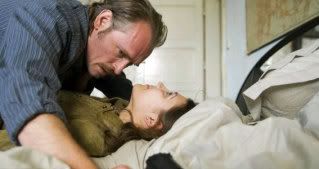
The title of this essay is "Claire Denis’ Cinema of the Skin"; all of this artist’s work involves the skin in one way or another. Whether it be the leathery, rugged skin of Michel Subor's aged body in "The Intruder," which Denis examines in leisurely takes; or the role racial power struggles play in both the director's debut, "Chocolat," and her best film, "Beau Travail"; or, in the strangest instance, the way that skin serves as a titillation in Denis' vampiric horror film, "Trouble Every Day." In each case, the beauty found in the frames of a Denis picture is natural, and imperfect, and skin is often her medium. It's the blemishes on Tricia Vessy's skin in "Trouble Every Day," and the moles and warts on the back of Subor, that give Denis' images texture-- she would have no interest in the "clean and clear and under control" skin that some advertisements promise. In this sense, the types of skin which Denis (and her cinematographer of choice, Agnes Godard) choose to film, could be seen as symbolic of this artist's belief in the natural as opposed to the synthetic. Her films reflect this, as all of them tell stories that, even when they skirt the line of fantasy, are grounded in real emotions and natural characterizations.
This approach unifies every film in Denis canon, and makes her an "auteur" in the classic sense. As does her decision to reuse actors; only seldom will you see a new face in a Denis film. She has a fondness for striking, French men: Alex Descas, Gregoire Colin, and the legendary Subor; and slightly awkward or abrasive looking women: Beatrice Dalle (who has a giant gap between her teeth), Florence Loiret-Caille, and the creepy Katia Golubeva (the latter of which is probably best known for her role in Bruno Dumont's chilling "Twentynine Palms"). Some could say that the filmmaker favors women less, in fact I've even heard accusations that Denis is misogynist (a claim which I find laughable).
Consider Claire Denis to be the inverse of someone like Pedro Almodovar; a male director who "loves woman," as he has claimed, and who often casts men in supporting, less-defined roles ("Volver," for example). Similarly, I think it can be accurately said that Denis loves men. Take "Beau Travail," which finds the director spending long passages to watch the men in her film exercise (an act wherein she keenly observes the homoerotic undertones). But what I think is fascinating about Denis is that her sexually-charged sequences never come off like an artist fawning over her subjects. I wouldn't say her films are clinical, just that Denis never judges or presents an opinion of what is on screen-- her presence is removed from our viewing experience. It's her job to give us images, and it's our job to interpret them-- if we detect a homoerotic undertone in "Beau Travail," that detection is neither right nor wrong.
Even the most straight-forward films of the director's career have often had a deep-seated meaning that's difficult to suss out. The mystery/procedural/slice-of-life entertainment that is "I Can't Sleep," based on the "Granny Killer" murders in France during the 1980s, is probably Denis' most character/plot-driven work, but it refuses to be taken at face value, or to conform to the expectations of what we think the movie would be about. The central character in "I Can't Sleep" is a Lithuanian woman, come to Paris of her own accord, who just happens to get involved with the murderer. Even here, in a film based on real events (the closest to non-fiction Denis has ever gotten in her narrative work), themes that permeate her most avant-garde films emerge.
In "I Can't Sleep," the murderer is a gay, black immigrant who never seems as lethal as he apparently is. He's involved in an affair with his accomplice, an older white man, who seems infinitely more sure of his actions. It may be a bit of a stretch to say that, like in "Chocolat" and "Beau Travail," the black character is being exploited by the white. However, all three of these films have a very common theme: that of cultural alienation. In "Beau Travail," it's a Russian legionnaire who arrives at a French outpost in South Africa, and who doesn't understand the conflict he becomes involved in. In "Chocolat," it's a young girl who moves to South Africa with her mother and father to live on a plantation, and who doesn't understand the conflict between her mother and their black servant.
In "I Can't Sleep," there are two foreigners at odds with their surroundings. Daiga, the Lithuanian woman, does not understand the announcement on her radio that warns of the "Granny Killer" (she knows very little French, as we learn soon after). And so it can reasonably be assumed that Camille (the killer himself), whose life collides with Daiga, and who's also an immigrant, may not comprehend the ramifications of his own actions (the film certainly implies that he is not very educated). And if Denis is suggesting this, then she may also be alluding to-- in a subtle sort of way that one may only pick up on if they consider the larger scope and thematic concerns of this director's work-- the discreet exploitation of Camille's circumstances, by his white lover.
It's also worth note that this theme is one that is hard-wired into Denis. "Chocolat," the director's most personal film, is relatively autobiographical (Denis had similar experiences when she was a child, growing up in South Africa). The feelings of cultural alienation felt by her characters take on a greater resonance when one considers that the filmmaker probably draws from her own experiences to render her subjects and their motivations. This goes a long way towards explaining how Denis is able to create such in-depth and believable characterizations.
However, above all else-- above even her incites as an explorer of human emotions-- Denis is an artist, and a great filmmaker. Her cinema is defined by moody atmospherics in such a way that makes each work (even her least successful) feel cohesive and complete. Her signature tone is established through patient and intelligent pacing, Godard's crisp and compelling visuals, and Tindersticks' Stuart Staples' idiosyncratic scores, which burrow into your head and echo for weeks on end (the reverberating cacophony of "The Intruder"'s musical accompaniment still haunts me). It's all of these elements which make her such a unique and valuable voice in modern cinema. And, it's the strength of each individual work she has crafted, and the daring topics she tackles with each new project, that make her truly incomparable.
This is a film that challenges patience and understanding in ways I can only describe as thrilling. To watch Claire Denis' "The Intruder" is to be engulfed in rapturous images more haunting than easily understood. Which is to say that Denis imbues every frame with a wealth of meaning, but what that meaning is exactly might not be apparent on a first viewing (or second, or third). It's a movie that asks to be felt rather than comprehended, and which communicates on an emotional level instead of engaging its viewers with a linear narrative.
This could be said about many of Denis' films; both her debut, "Chocolat," and her defining work, "Beau Travail," were loosely told and often felt like dreams (and both consisted of flashbacks that never seemed like the Hollywood definition of a flashback). But it's "The Intruder" that truly breaks free of the binds of a traditional narrative-- that which hampered prior works like "Trouble Every Day," which is bogged down by its tedious plot, and "I Can't Sleep," which is more straight-forward then her later work. Here, Denis seems to have arrived at the endpoint of an evolutionary cycle, where plot is less and less important and stories can be told through related but ambiguous sequences that resonate in their thematic similarity.
Denis has described reading the source material for her film-- a 30-page novella by Jean-Luc Nancy-- as a "physical" experience. As such, though her film adaptation is clearly more expansive than the literature (it runs for just over two hours), at least the director has effectively translated this same "physical" quality to the screen. Similarly, Denis describes her reaction to the novella as being "personal," and the same can certainly be said of my own reaction to her film, and what I took away from it. What's more, both works are meant to intrude on those who let them. In the film, "the intruder" is everywhere, and anyone who does not belong, or who penetrates the life of another. For instance, as you read this review, I am the intruder.
A poetic incantation, spoken by a specter hiding in the shadows of the woods, begins the film: "Your worst enemies / are hiding inside / in the shadow / in your heart." In this film, "the heart" means a lot. Louis Trebor (Michel Subor) is a "man with no heart" (as described by Denis), who suffers from pain in his chest and, eventually, learns that he needs a heart transplant. This 'inciting incident' (though such screenplay cliches are superfluous here) sets him on a path of redemption and reconciliation, where he must leave his life of solitude in the woods (on the French-Swiss border), find a way to spiritually reconnect with his two sons-- one lives close by, the other far away-- and quell the demons of his consciousness. Demons that manifest themselves in the form of one entity; a ghostly Russian woman (Katia Golubeva), the same who whispered the poetry from the film's opening sequence. She is an "intruder"; she haunts Trebor on his journey through lands both strange and familiar, harsh and cold, inviting and tropical.
I've seen the film four times, and each time I come back to it I make the same mistake. I try to make sense of the story, of the relationships between the characters; which is to miss the point. The only story I've found, aside from the baseline-- a man in search of a heart-- is that which Denis communicates through the stringing together of like-minded sequences. For instance, towards the beginning of the the film, a female cop is seen performing routines with a trained dog (an animal that appears in this film quite a bit), suggesting a position of authority and control. In the next sequence, she heads home to her husband, who seduces her quietly in the kitchen; she is submissive now, no longer in control of her environment. Denis then cuts away to shots of shadowy, faceless figures, bounding through the forrest, hopping over a fence, and intruding on both Trebor's property and the tranquility of the forrest-- as well as the moment itself. The way in which Denis subtlety likens a sexual intrusion to that of the intruders in the woods demonstrates this director's thought process. Even if the two sequences exist separately from each other, on a narrative level, they are linked in that the action of both scenes is the same: an intrusion. The filmmaker further entwines the two disparate occurrences by having the husband weave a forested sexual fantasy for his titillated wife, creating a fluid transition from one scene to the next.
This scene, and others like it, suggests the power of imagery conjured by the imagination, a running theme here that is explored again later in the film, when Trebor imagines he's being dragged through the snow by a horse-drawn sleigh. Perhaps this is symbolic of the guilt Trebor feels (he kills a young man, out of impulse, towards the beginning of the film), or maybe he just dreads the idea of being dragged back to the snowy landscape he's left behind. Or, maybe, the sequence isn't a dream at all. The fact that Denis opens her cinema up to so many interpretations should be considered a strength, not a flaw, as ambiguity must be valued in this age of modern cinema, where so many filmmakers spoon-feed us. In contrast, Denis lets her scenes speak for themselves, without exposition, which could be seen as something of an auteurist trademark. Ditto her decision to tie characters to their surroundings, making them seem unfamiliar if they're spotted elsewhere. This serves to emphasize a sense of alienation from the world outside ones own environment, and helps to establish Trebor and his ghostly, Russian companion as the only roving beings in a world plagued by stillness. This could be why I've read in many places that those who watch "The Intruder" tend to feel as if they are on some kind of journey themselves, or that they've "lived something," as Stephanie Zacharek of Salon astutely observed.
Even those who argue that the film lacks structure or a sense of pacing don't have a leg to stand on. First of all, that is the point; to rebel against traditional narrative and to tell a story that cares more about making its feelings resonate then following a plot from point A to point B. Regardless, I think the movie has impeccable structure, as becomes apparent when it enters into its third act-- set in the tropical landscape of Tahiti-- where Trebor finally arrives, in search of his long-lost son. The movie follows the linear timeline of a dying heart. The pace suggests this, as it slows considerably in the final act, leading to the inevitable. And the final sequence-- a return to the snow-covered landscape Trebor left behind-- suggests something profound and cyclical. In addition, a final glimpse at the Queen of the Northern Hemisphere (as the credits refer to Denis regular Beatrice Dalle's abrasive character) hints at the fact that redemption may be unattainable for Trebor's sinful soul.
The result of all this is a film that feels at once alien and familiar. There's a certain disassociation I feel when I watch "The Intruder," but the impression it leaves tends to linger for a long time after each viewing. Which, in my view, is the point; Denis intrudes, as is her intention, and the effects of her intrusion are long-lasting. Understanding it all doesn't really come into the equation.
Grade: 3.5
"Trouble Every Day" is Claire Denis most disliked film. Even among her ardent fans, the feature is often seen as something of a failure (unless, of course, they happen to be one of the movie's few, fervent supporters). I, however, fall somewhere in the middle; I acknowledge its many flaws, but can't shake its haunting visuals. I'm consistently drawn to this bold material: an erotic parable which imagines a world where a certain group of afflicted individuals engage in sex as foreplay to violence; a predatory process which awakens in them an intense primal urge to attack and kill their partner (taking rough sex to a whole new level).
The idea for the film began with a nightmare the director had when she was a child, wherein her mother's goodnight kisses morphed into vicious bites. This concept-- the fine line between lip and tooth-- manifests itself right at the outset, when a couple is seen making out in their car, scored by Stuart Staples' (of Tinder Sticks) tension-racked orchestration, establishing dread and suspense that would normally give way to some kind of brutal action. But this is not a traditional horror movie, and such violence doesn't take place at this time. Denis understands that patience is a bedfellow of suspense, and fulfillment comes later.
While making a short film in New York City, a friend of hers in the industry asked Denis if she might be interested in making a genre film. Her response, many years later, is "Trouble Every Day," which is in many ways not a genre film at all. It bears resemblance to various vampire movies, and the director claims that she's always been interested by that particular creature's mythology, but she hesitates to count her film among those that explore it. And understandably so; there's a brutality of an entirely different persuasion in "Trouble Every Day." Sucking blood is not so much the motivation here; instead, the afflicted are prone to ravaging the bodies of their prey with a primal urgency, spattering the screen with blood. Not gore, however, which is an important point to make, as Denis claims (and I'm inclined to agree). The director makes no apologies for the blood in her films, but she insists that there is no gore, and that the term implies a certain "nihilism" which her film does not posses.
At first, "nihilistic" struck me as an accurate way to describe "Trouble Every Day," as its bleak vision of an alienated people living with very little hope of a normal life suggests. But, upon further examination, to designate it at such is to overlook the love shared between these characters. Core (Beatrice Dalle), for instance, is possessed by this bizarre malady and cared for by her handler, Leo (Alex Descas), who's also her husband. The heartless way in which Leo unleashes his wife on unsuspecting victims (a chilling introduction to both characters) is given further dimension through an undercurrent of melancholy, evidenced by regret written all over Descas' face. Leo is not an evil man; he's a desperate one, obligated to carry out this horrifying procedure to keep his wife alive. Similarly, the relationship between the infected Shane (tall, dark and creepy Vince Gallo) and his new wife June (Tricia Vessey) is one of great affection, and their on-screen romance contrasts that of Leo and Core. The latter two find themselves disassociated from each other, accepting the inevitability of their circumstance, and living selfishly. Shane, on the other hand, represses his violent urges, and fighting his condition in hopes that he can have a normal life with his partner.
Much of the film is devoid of dialog, as is the case with many Denis films, placing emphasis on tone and atmosphere-- again, nothing new for those familiar with the director's unique brand of storytelling. But, unlike Denis' best films ("Beau Travail," "The Intruder"), the plot which emerges here is needlessly confusing and distracting: something involving Leo (who's apparently a scientist of some kind), his involvement with Shane, and the research both have done in effort to cure this debilitating disease. The specifics are left vague, and an attempt to establish a preexisting relationship between Shane and Leo's wife, Core (they were perhaps once lovers) is headache-inducing. And yet, as much as this unintelligible plot does serve to dilute the purity of Denis' visceral cautionary tale-- one far more chilling than, say, "Basic Instinct"-- it's the intrigue this concept commands that makes the film compelling.
Emotionally-charged sequences, shot sublimely by the reliably brilliant cinematographer Agnes Godard, burn into the memory. These include basically every tense moment and longing glance shared between Shane and June, who yearn to connect with each other so completely that Shane occasionally forgoes caution, and gives in to temptation; only to be stifled by a mark on June's shoulder, reminding him of past transgressions and of his own limitations. Scenes like this perfectly encapsulate Denis' thematic concern: dangerous love. As such, "Trouble Every Day" becomes so much more than a "hysterical yet humorless disquisition on the thin line between sucking face and literally sucking face," as one critic naively has described it. It's a movie which concerns itself with the relationship between allure and danger, asserting its theme forcibly, with every lustful glance and pining gesture. Some may find this approach too subtle, preferring that the director lecture us and present us with some kind of metaphorical iteration (a filmmaker less trusting of their audience may slap on a narration to drive the point home, something like, "a rose is gorgeous, but it has thorns").
"Trouble Every Day" is all about inaction, and so most horror enthusiasts will likely be repelled by the quiet moments, which make up the majority of its runtime. However, this sparseness is necessary, as it enables the two instances in which violence does take place on screen to be all the more jarring. Both these sequences are nearly-unwatchable in their unrelenting brutality, and will likely disturb the viewer more than anything that, say, the 'Saw' franchise has to offer. Which is why, thankfully, they are used sparingly-- as exclamation marks, not sentences-- and so I find them to be necessary evils that elicit the reaction required to understand this particular piece of art on its own terms. They're not entertaining or even titillating (both take place during sex). They're sadistic, but they serve a purpose: cautioning the fulfillment of lustful desire.
An agreeable tone is established early on, and the movie effortlessly coasts by for much of its duration. Staples' soaring strings, tapping percussion and shakers score panning shots of skin, photographed by Godard like the rosiest of apples; as seductive to the viewer as to predators like Shane and Core. Like many of Denis' films-- though, admittedly, more fascinating here than anywhere else in her oeuvre-- the roll that skin plays is intrinsic to the narrative. Not only is it shot to look delectable and inviting, but it's treated as delicate and easily damaged; the thin layer of protective coating separating the afflicted from their sustenance. In fact, the film's power of suggestion, and its effectiveness as an allegory, make it hard to admit its many and glaring flaws.
At its least effective, "Trouble Ever Day" feels over-thought (not a common attribute of a Denis work), and far too literal (ditto). The worst scenes tend to involve Leo and his many bizarre experiments. When the plot shifts into mystery/procedural territory towards the end of the second act, its overly scientific preoccupations (talk of neurological disorders and brain samples in petri dishes) fly in the face of the narrative's more naturalistic progression, and the almost innate, animalistic behaviors of these characters. It's occurred to me that Denis may be trying to make some kind of statement on the futility of man-made serums and scientific solutions in combating basic human nature, but if that is the case, her argument is both vague and abstract.
Despite all of this, Denis overcomes, and delivers a thesis both controversial and undeniably thought-provoking: The director posits that all desire-- sexual, violent, or otherwise-- is intrinsically linked. Just as blood and skin are the same (part of our DNA), carnal urges are equivalent to violent urges, and the two exist on the same plane of fulfillment. The separation, essentially, is defined by an individual's own ability to control their actions in the heat of the moment. It's a theory which virtually no genre film would have the audacity to suggest, and I can think of few concepts more terrifying.
Grade: 2.5

This is Claire Denis' masterwork. "Beau Travail" is an adaptation of Herman Melville's "Billy Budd," relocated to a French legionnaire camp in Northern Africa, where jealousy and braggadocio inform an intense power struggle and elevate a classic parable to the level of Greek tragedy. Galoup (Denis Lavant), perhaps the ideal legionnaire-- stoic, solemn, dedicated-- looks after his soldiers like a "watch dog," as he puts it, for the recognition of his superior, Commander Bruno Forestier (the legendary Michel Subor), whom he idolizes and whose respect and attention he yearns for. It's only when a foreigner arrives, Russian legionnaire Gilles Sentain (Denis regular Gregoire Colin), that this delicate balance of power is upset-- that which has isolated Galoup and Forestier from the lower ranking legionnaires; here portrayed as nameless, without identity, and part of a pulsating, muscular machine. Sentain performs one heroic act-- rescuing the survivors of a helicopter crash-- and earns the attentions of Forestier. Galoup, already suspicious of the Russian legionnaire, becomes consumed with jealousy, and sets about to "destroy" the young soldier.
In the opening scene, Sentain and Galoup circle each other predatorily, as if they were competing for the same lioness; the two soldiers are established as silent rivals, as conveyed through intense physical gestures: penetrating stares, arched backs, clenched fists. Denis constructs an environment where the line is blurred between machismo and homoerotic tension, and spends much time watching the men exercise; an act which suggests both inclinations. This director's cinema is all about suggestion; erotic tension abounds, but no fulfillment. When Galoup gazes at Forestier is it with desire or admiration? Is Sentain aware of the reason for Galoup's contempt, or does he simply think that his superior is pushing him, taken a dislike to him for some other reason? When a helicopter crashes, the explosion is witnessed fragmentarily, from beneath the water. The next take is longer, watching the wreckage bob steadily in the waves. Denis' focus is inaction rather than action; the soldiers rehearse tirelessly for a battle that never comes, and their usefulness only manifests itself when they're called upon to rebuild a road. This may be why Denis' film is so suspenseful and full of tension, a kind that's hard to pin down. The themes of her filmography are all present: the relationship between the French and Africa; unspoken sensuality; and an emphasized physicality that is as ambiguous as the intentions of her characters.
Blacks often become the casualties of senseless conflicts between the white characters. When one black soldier leaves his position briefly the act, which would normally be acceptable, gives Galoup the opportunity to set a trap for Sentain. Galoup punishes the black soldier, making him dig a hole until he gives the order to stop. He does this only to provoke Sentain, and to force him to act out of line himself. A shot of the black soldier's hands smeared with blood illustrates France's exploitation of Africa as poignantly as any shot in modern cinema, and recalls the final sequence in Denis' debut, "Chocolat." It's this contrast between surreal beauty and striking brutality that makes the director's films (particularly this one) so compelling, and her stylized visuals truly meaningful-- for that, Denis can thank her reliably brilliant cinematographer, Agnes Godard. What emerges is film of a rare quality; a poeticized Greek tragedy, hushed and restrained, communicating on a visceral level through body language. Denis' characters lumber across the screen, exhibiting a silent yet forceful command of their terrain, a control which mirrors that which the director has over her material.
Grade: 4

Leave it to Claire Denis, a director more in touch with humanistic sensibilities than perhaps any other living filmmaker, to take a simple plot (based on a true story) about a couple of thugs who kill elderly woman for cash, and turn it into a complex study of sinful behaviors. In the hands of just about any other filmmaker, "I Can't Sleep" (this director's third film) would most likely have become a murder mystery procedural. Denis, however, harnesses the tenseness of this material for different purposes. "I Can't Sleep" stretches itself across a nearly two-hour runtime, patiently and evenly developing its many characters. Much of it takes place in the grimiest of Parisian city streets, in the nighttime, where these sinners sin and dread the coming daylight. At the center is Daiga (Katia Golubeva), a tall and wispy Lithuanian beauty, who comes to visit a relative in Paris, and to find work. She doesn't speak much French, and so when a radio announcer warns of the "Granny Killer," she doesn't understand; the audience, however, does. Daiga's character in "I Can't Sleep" serves as our entry point into this dark and surreal world, and in it we feel just as uprooted as she does-- and just as fascinated, too. Denis has said that she wanted us to "discover" the killer in the film, in much the same way one would discover a story like this in a newspaper. It's a daringly anti-dramatic and natural approach, and it pays dividends in the last act, when insight into the mindset of the killer is gained through our understanding of Daiga, an outsider who stumbles into the middle of something sinister (just like we do). It's through Daiga's alienation that we come to understand Camille (Richard Courcet), a transvestite immigrant from Martinique who we learn commits the heinous murders in the film with his white, older lover. Camille lives a dangerous life, one of prostitution and drugs. In contrast, his older brother, Theo (Alex Descas), chose the preverbal high road-- he has a kid and a job. But Theo gets no more respect for it, as an early scene shows; a Parisian woman tries to scam Theo out of a couple hundred francs. Denis clearly does not find the immigrant experience in Paris to be ideal. But if that's her message, at least she doesn't hammer it home too hard. Instead, she's content to free her film of message-pedaling and traditional narrative structure. What she gives us in its place is something that approaches the illusive idea of "pure cinema." Characters are formed around their actions and interactions with other people, and through them the film finds its tempo. Theo's wife (Beatrice Dalle) is selfish, taking off every time she and her husband get in a fight and threatening never to come back. Just as Daiga is ultimately defined by her greed (as becomes apparent in the last act). There are no heroes in "I Can't Sleep"; innocence is scant, and certainly not without counterbalance. But the city visibly fights back against this corruption-- granny's take up martial arts to defend themselves, the cops show up everywhere, and those with any shred of humanity reach out to others, often in vain. Denis is too smart to create a film rote with cynicism, so she finds the gray areas, even tender moments shared between flawed individuals-- when Camille dances with his mother, an act of compassion, you could be forgiven for forgetting that he's a murderer. Denis understands that people sin, but she also knows that they regret. The title of her film may suggest that even the most grave of offenders lose sleep over their transgressions.
Grade: 3

Born in Paris, but spending much of her childhood in Africa, where her father was stationed as a French Official, Claire Denis is a filmmaker well attuned to racial politics. She has said in interviews that her family moved often, changing houses every couple of years just so they could come to understand the "geography" of the region. This also, it's safe to assume, helped her better comprehend the culture and its people. Each one her films exemplifies this understanding, but it's her first feature, “Chocolat,” that uses that knowledge specifically to form its narrative. This is also the only work by this artist that could be rightfully considered autobiographical. Set in Africa, during the same period in which Denis grew up, the film traces the experiences of a young girl whose adolescent life bears much similarity to Denis' own upbringing. But before the director introduces us to that world, she first employs a plot-framing device I usually find constraining, making it work on her own terms. Without narration, she sandwiches the meat of the film between two present-day sequences; an equally stellar prologue and epilogue involving France (a person, not the country), an adult, visiting Cameroon, Africa after years away from the land where she grew up.
In the opening sequence-- a series of images wherein not a word is spoken-- Denis delivers her thesis. The first shot depicts France sitting awkwardly on a log, wearing headphones and looking very out of place in her environment; the next shows a black man and his son playing in the water, then laying down and letting the waves wash over them, as the dark and muddy soil cakes their skin; finally, one more shot of France, before cutting to a close-up of her foot as she scrapes the very same dirt from between her toes. Denis, as she often does, makes her point without dialogue: No matter how hard foreign colonists like France try to acclimate themselves to African culture, they cannot blend in, just as this young woman and her ivory skin will always stand out against the country's black soil.
Flashback a couple decades. We're now situated during the waning days of French colonialism in Africa. France, here only seven years old, rides along contentedly, in the back of a pickup truck with her houseboy, Protee (Isaach De Bankole). The dynamic set-up by this sequence (France and Protee in the back of the truck, the girl's parents inside it), illustrates the emotional distance France feels from her parents-- the effects of which her adult incarnation displays-- just as it also informs of Protee's role as a surrogate parent. Aimee (Giulia Boschi) and Marc (Francois Cluzet) Dalens are France's real parents, and the latter of the two spends much time away from the family's plantation home in Cameroon, due to his line of work. Which is why, in absence of a male paternal figure, Protee is left to fill the role. He accepts the task, and cares for the child, giving her the attention her father does not. But Protee is confronted with another role, one which doesn't suite him; that of the alpha male, the 'man of the house.'
It's for this reason that Aimee often treats Protee so coldly, as she's rebelling against his near-inevitable ascension to her level, and to his role as the dominant male figure in the Dalens family home. Aimee desires him; her glances and gestures (however coded) often suggest as much. This is especially true in one key scene, set in Aimee's bedroom, where she invites Protee inside to button her dress and their eyes meet through the reflection in a mirror. It's his lower rank that keeps Aimee from acting on her apparent emotions, and if that invisible line of class separation were to cease existing-- as it eventually does-- there would be nothing to stop her. Unfortunately for Protee, Aimee's erratic behavior confuses his sense of boundaries, which causes “Chocolat”'s most devastating scene to occur. This is spurred on by a string of events that begin with the scene by the mirror, and continue in a later sequence; Protee enters Aimee's room without receiving permission, only to be ordered away by his mistress. The culmination of these events comes while Protee is at his most bare and vulnerable, showering out doors, in broad-daylight. All it takes is the sound of Aimee's voice, returning from a picnic with France, to make him crack.
In the scene, Protee sobs uncontrollably (one of the few if not only times we see the character display such emotion), and I remember at first believing this to be a manifestation of his own frustrated feelings of unfulfilled love. But, as I've come to understand, the film suggests the contrary and I'm now convinced that neither of these characters love each other at all; in fact, Protee may not even like Aimee very much. It makes more sense to conclude that, in this moment, Protee experiences a welling up of shame which overpowers his usually stoic resolve. The weight of his circumstance, and his quality of life (or lack thereof) is crippling, and the voice of this woman, whose feelings towards him he may not understand, is too much to bear.
Throughout, France exists in the background, a conscious observer, like the audience. But she's far from passive; she engages in the most vital of actions on screen: learning. What she learns from her mother is most difficult to articulate; it's probably easier to suggest that she inherits her mother's removed fascination with the culture of Africa. What she learns from her father is far more concrete: he imparts to her a line as symbolic as any in the film, one which designates the horizon as an "invisible line" (an obvious but nonetheless effective metaphor for the same undefinable line which separates Protee and Aimee, and their respective classes). Still, what France learns from Protee is most vital, and is communicated in yet another excellent scene. France visits Protee and points to a generator pipe, asking if it's hot. Protee responds by reaching out and grasping the pipe, so France does as well, withdrawing her hand quickly when it burns her. This cannily illustrates the old adage "if you play with fire...," but it also teaches France a valuable and unforgettable lesson about the dangerous nature of trust. It's the most significant act Protee takes as France's guardian, equivalent to a mother bird throwing her chick out of the nest, to teach it how to fly.
“Chocolat” has a sensory effect on many different levels. It's a passionate work full of sexual tension (however indefinable and subtle); it works as a wholly realized commentary on race relations, and on the relationship between Africa and the 'civilized' world; and its landscapes, though deserted and desolate, exude an awe-inspiring beauty and tranquility that pleases on a visual level. The more one considers the craft on display, and the intricate symbolism woven into the plot, the more it becomes increasingly impressive to think that this is a debut feature. Even on her first time out-- granted, after collaborating as assistant director with some of world cinema's most daring and original artists (Wim Wenders, Jacque Rivette)-- Denis had already developed a very specific and affecting formula, and she accomplished all this while working with a story so personal. Denis may have been a late bloomer (she didn't make this film until she was 40), but her first work feels as impeccable and studied as any she's made since.
Grade: 3


 Posts
Posts